Building the Panopticon: The doorbell camera version

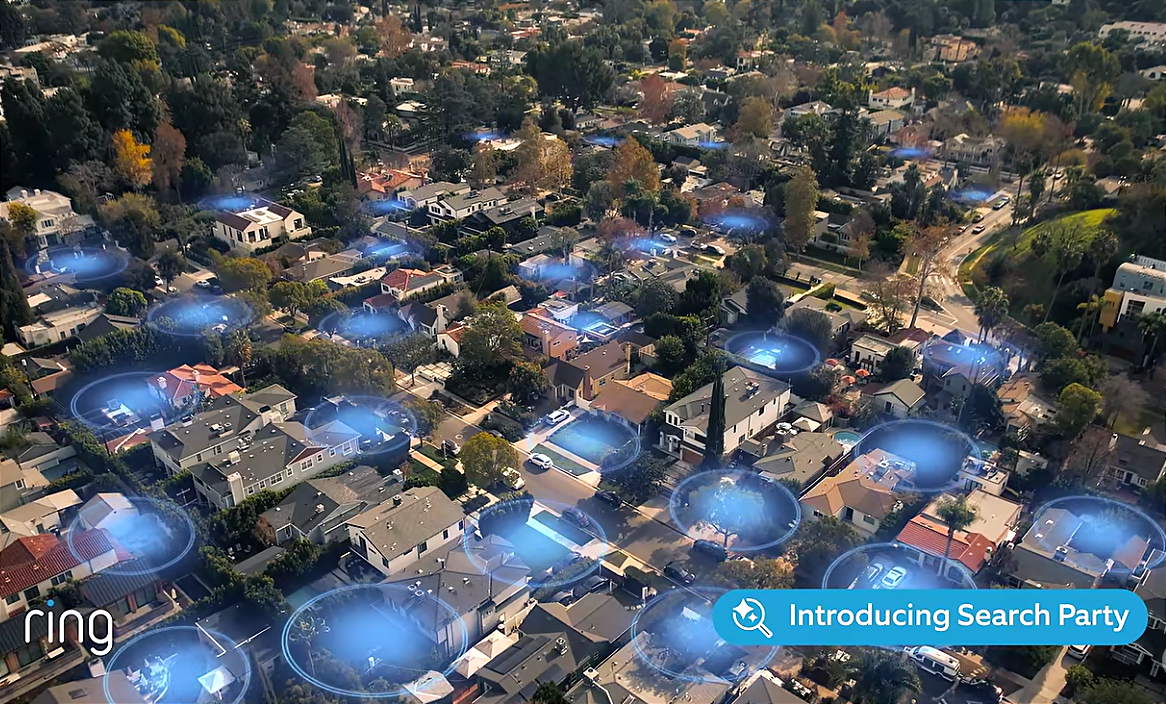
If you watched the Super Bowl last weekend and are either located in the United States or have access to the American commercials, you might have seen a heartwarming ad for a new feature of Amazon's Ring doorbell cameras, called Search Party. The ad shows people putting up posters about their missing pets. A little girl's new puppy seems to be missing, so her dad turns to the Ring Neighborhood app and Search Party makes hundreds of doorbell cameras in the neighborhood come to life. The footage from them is used to identify the missing dog in a matter of minutes. We should be grateful that we have technologies that can help us in such situations, right? Well, no. In effect, what Amazon showed us was a massive, panopticon-style video-surveillance network. Does this sound heartwarming? Not really. Especially when it's combined with other disturbing things that are going on in the United States surveillance-wise.
Privacy expert Chris Gilliard told 404 Media that the ad was “a clumsy attempt by Ring to put a cuddly face on a rather dystopian reality: widespread networked surveillance by a company that has cozy relationships with law enforcement and other equally invasive surveillance companies.” Senator Ed Markey posted on X that the Search Party feature "definitely isn’t about dogs — it’s about mass surveillance.” Coincidentally, Ring recently announced a new feature called Familiar Faces, which it says uses AI to recognize people who have appeared on your Ring doorbell camera multiple times. It can recognize them up to 13 feet away from the camera, and it works along with Ring's 24/7 Continuous Recording feature. It also notes that the feature is "not available in: Texas, Illinois, Portland (OR), or Quebec (Canada) due to legislation."
Ring spokesperson Emma Daniels told The Verge that Search Party is only designed to match images of dogs and is “not capable of processing human biometrics” – or at least not yet, anyway. She added that the facial recognition feature (which isn't enabled by default) is separate from Search Party, and operates on the individual account level, with no communal sharing. Asked whether the Search Party feature could be used to recognize human beings rather than just dogs, she demurred, and also evaded the question when asked whether Ring's facial-recognition software could be used to track individuals, or be used by police agencies or ICE. Using an existing feature, Ring users can currently share footage from their cameras voluntarily with local law enforcement agencies through a feature called Community Requests.
As The Verge explains, community requests are handled by third-parties — currently through Axon, the company that manufactures Tasers and other security equipment. Soon, these police requests will also be handled through a partnership with a company called Flock, which says it offers "AI-powered tools designed to help law enforcement agencies streamline investigations, integrate data across systems and improve efficiency in identifying criminal activity." Ring says it partnered with these companies because their evidence-management systems offer "a much more secure chain of custody." (A Ring disclaimer on the website says it complies with search warrants and subpoenas, but that it "objects to legal requests it determines to be overbroad or inappropriate"). Ring says it will ensure the information shared with Flock will be used by local public-safety agencies such as police, fire and EMS only. However, as The Verge noted:
The problem is that there’s nothing preventing local agencies from sharing footage with federal ones. And while the Super Bowl ad played up heartwarming images of a girl reunited with her puppy, the leap to this technology that can track people in your neighborhood is still very small. Combined with government overreach, it’s not hard to imagine how a powerful network of AI-enabled cameras goes from finding lost dogs to hunting people.
Note: In case you are a first-time reader, or you forgot that you signed up for this newsletter, this is The Torment Nexus. Thanks for reading! You can find out more about me and this newsletter in this post. This newsletter survives solely on your contributions, so please sign up for a paying subscription or visit my Patreon, which you can find here. I also publish a daily email newsletter of odd or interesting links called When The Going Gets Weird, which is here.
Tip of the surveillance iceberg

One reason to be suspicious of all of this is that Ring has a history of working with the police and handing over its camera footage at the drop of a hat — without even requiring a warrant (in 2020 police requested video footage from the company's cameras more than 20,000 times). Also, founder Jamie Siminoff, who recently returned, has talked about how he sees the company's products and the use of AI as a way to "zero out crime." That sure sounds like using the camera footage and features like Search Party and facial recognition to track down criminals. The question is: Who gets to define what a crime is? ICE and Homeland Security have defined just about anyone who isn't a white Republican, and certainly anyone who protests its activities (or even just writes things they don't like) as a criminal. Is that the kind of crime we're talking about? In one case, a Texas cop searched more than 83,000 cameras to track a woman who had an abortion.
Also Flock has already worked with multiple law-enforcement agencies who aren't local, including ICE and the secret service. 404 Media reported last year that data from a license plate-scanning tool — primarily marketed "as a surveillance solution for small towns to combat crimes like car jackings or finding missing people" — was being used by ICE. Local police forces around the country were reportedly performing lookups in Flock’s AI-powered automatic license plate reader (ALPR) system for “immigration” related searches and as part of other ICE investigations, giving federal law enforcement side-door access to a tool that it currently does not have a formal contract for. The massive trove of lookup data showed more than 4,000 nation and statewide lookups by local and state police done as an “informal” favor to federal law enforcement. These investigations, which Flock can tie to specific personal details, are done without a warrant.
As the Electronic Frontier Foundation pointed out in a piece on Search Party, Ring's cameras feature microphones that have been found to capture audio from the street, and just two years ago the company reached a settlement with the Federal Trade Commission and paid almost $6 million because it was found to have given both its employees and outside contractors extensive — and unpublicized — access to the footage from its cameras. At that time, just three years ago, the FTC wrote: “As a result of this dangerously overbroad access and lax attitude toward privacy and security, employees and third-party contractors were able to view, download, and transfer customers’ sensitive video data for their own purposes.” Only after the settlement did Ring require its staff to get the consent of users before their footage was downloaded or shared.
Ring and Flock are just the tip of the surveillance iceberg. Google, of course, has its own cameras, and it — like Amazon — has a policy whereby it will hand over footage upon request without a warrant (and presumably without telling the user), but of course it will only do this in "emergency situations" (Google says this includes "bomb threats, school shootings, kidnappings, suicide prevention, and missing persons cases"). And speaking of missing persons, Google recently helped provide camera footage of the potential kidnapper of Nancy Guthrie, mother of Today Show host Savannah Guthrie, who was abducted about a week ago. The reporting notes that Google was able to recover camera footage from the cloud even though the owner hadn't signed up for that service.
Pima County Sheriff Chris Nanos initially said there was “no video available” because Guthrie “had no subscription” to Google’s video recording service, which keeps videos from Nest cameras accessible in Google’s cloud. But Nest still saves around three hours of “event-based” video history for free before being deleted. That data lives in Google’s cloud and servers. Even if the data had been deleted from Google’s systems, it could still exist somewhere and be recoverable because even files slated for deletion can exist until they are overwritten.
Dogs might be safer but you are not

While it's not camera-related, The Intercept recently reported that Google gave ICE a student's credit-card information and bank account information because that student had "attended a protest targeting companies that supplied weapons to Israel at a Cornell University job fair in 2024 for all of five minutes." The outlet had previously reported last fall that Google handed over information as a result of an ICE subpoena — without notifying the student, or giving him a chance to challenge it — but it wasn't clear exactly what information it provided. A copy of the subpoena shows that it included usernames, addresses, services — including VPNs — phone numbers, and credit card and bank account numbers. The only justification for why ICE wanted this information was to say it was “in connection with an investigation” and the agency asked that Google not “disclose the existence of this summons for an indefinite period of time.”
In a recent edition of The Torment Nexus, I wrote that surveillance of public citizens "was already bad, and it's getting worse." This was a follow-up to a previous post on how the Trump government was building a "panopticon," a way of searching hundreds of databases with tools from companies like Palantir. I mentioned that an ICE contractor had the ability to monitor more than 200 social media services, and could scan for content deemed "derogatory" to the US — including searching the system for identifiers such as name, address, email address, and country of citizenship. Analysts can click on a specific person and review images collected from social media or elsewhere, as well as reviewing their “social graph,” potentially showing who the system believed they were connected to. Now add camera footage and facial recognition to that.
ICE is also reportedly using two tools known as Tangles and Webloc to track the location of cellphones without a warrant. Nathan Freed Wessler, deputy director of the ACLU's Speech, Privacy, and Technology Project, told 404 Media that Webloc "is a very dangerous tool in the hands of an out-of-control agency. This granular location information paints a detailed picture of who we are [and] where we go." While Webloc tracks a phone's location over time, with significant granularity, Tangles is a social-media monitoring tool that can detect faces in images and then identify them based on other public data. It can also do a sentiment analysis on a person's posts, categorizing them based on emotion. This has been used in the past to monitor the posts made by protesters at Black Lives Matter events.
As part of the hundreds of millions of dollars it is spending on surveillance-related service, ICE has also invested in biometric surveillance tools, including facial-recognition software called Mobile Fortify to scan the faces of people they stop at protests or elsewhere. The software checks the pictures it takes against a database of 200 million photos (the source of the photos is unknown). ICE also has a $10 million contract with Clearview AI for face recognition, and it has contracted with a company that offers iris scanning (agents have also been spotted wearing Meta’s Ray-Ban video-recording sunglasses).
Each of the most recent incidents I mentioned at the top can be seen in isolation: Ring has a feature that lets you search for a missing dog, but it only recognizes dogs; it also has a facial-recognition feature, but doesn't plan to use it except to identify your mother or the pizza guy; Ring also works with Flock to give camera footage to local law-enforcement, but only in emergencies; Flock sometimes does searches of its licence-plate reading cameras and gives the data to ICE or the secret service; Google stores video data from its Nest cameras in the cloud even if you haven't signed up for that service; Google will also hand over to ICE your personal information, including bank-account data, but won't tell you. In isolation, these may seem uncontroversial — but in aggregate? And when combined with the vast surveillance system ICE has built? Panopticon.
Got any thoughts or comments? Feel free to either leave them here, or post them on Substack or on my website, or you can also reach me on Twitter, Threads, BlueSky or Mastodon. And thanks for being a reader.