It's the end of reading as we know it! It's the new Dark Ages!

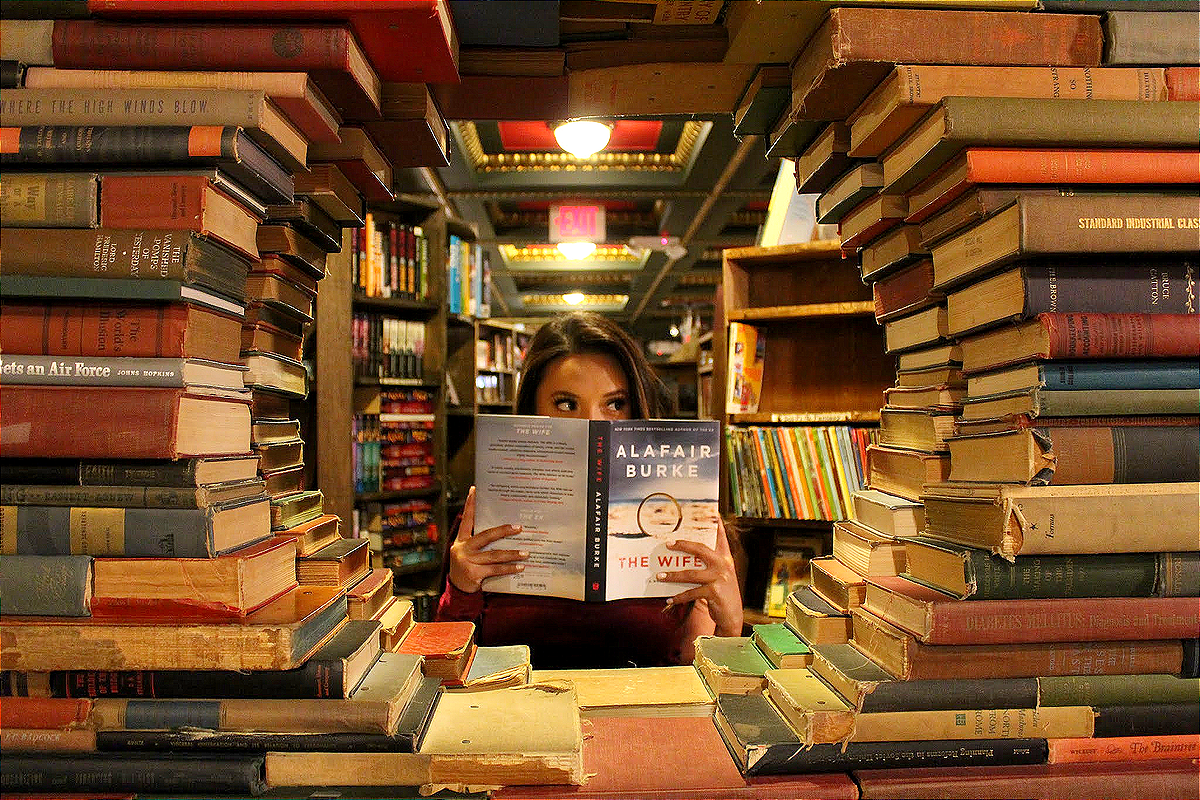
If you read The Atlantic, or you follow a lot of writers on Substack — or virtually any other writing-focused website or form of social media — you will already know what this post is about: The Atlantic published a piece recently entitled The End of Reading, the subtitle of which stated that "the age of reading might be a short anomaly in human history." The piece begins with a lyrical description of the famous Library of Alexandria, which King Ptolemy the First intended to be the repository of all human knowledge at the time. The king reportedly paid scholars to live and work in the library, we are told, and the collection was available to anyone “eager to study, an encouragement for the entire city to gain wisdom,” according to a visiting Greek writer. Eratosthenes allegedly calculated the circumference of the Earth there, and Zenodotus edited the earliest manuscripts of Homer’s epic poems. The library eventually disappeared, The Atlantic tells us — in part because Julius Caesar set it on fire, and then the temple housing some of the manuscripts was sacked in the 4th century, but also for other reasons:
Contemporary historians tend to dismiss the importance of these dramatic incidents in favor of a more mundane cause of death: negligence. Maintaining the collection was an enormous expense. Humidity, mice, and insects slowly ate away at the papyrus scrolls. Scribes had to continually copy old texts before they deteriorated and became illegible. Eventually, the challenges of maintaining the library became greater than the will to preserve it. “It is not that the disappearance of a library led to a dark age, nor that its survival would have improved those ages,” the classics scholar Roger Bagnall has written. The fact that the library was allowed to die showed that the dark age had already arrived. Some 2,000 years later, under very different circumstances, the darkness is gathering again.
"The darkness is gathering again." In other words, welcome to the new Dark Ages! If this seems a little over-the-top to you, you aren't the only one. And what kind of evidence does The Atlantic produce to justify this apocalyptic pronouncement? Americans (who are "once members of a proudly literate society," according to the magazine, although that could definitely be debated) read much less than they used to, we are told. In a study by the National Endowment for the Arts, fewer than half of all adults reported having read a book of any kind in 2022, and a study analyzing 236,000 responses to the American Time Use Survey found the proportion of Americans who read for pleasure on any given day fell from 28 percent in 2004 to 16 percent in 2023. The decline "cuts across age groups, gender, and education levels," The Atlantic says, and even the demographics that traditionally read the most — retirees, women, and college graduates — have seen "a collapse" in their reading habits over the same period.
If we dig down even a little bit, however, it becomes obvious that the point is not that people aren't reading, it's that they aren't reading the right things. In the American Time Use Survey, The Atlantic says that "only 38 percent read a novel or short story." The horror! Also, the piece goes on to say that the books people do read are "simpler than they used to be." New York Times best sellers today apparently have sentences that are about one-third shorter than they were a century ago — although the piece immediately reassures us that longer sentences "aren’t inherently better" (Heminway would agree). But the fact that the sentences in books have shortened so much suggests there was a time when "Americans had the inclination and ability to read serious works of literature," according to The Atlantic. In 1958, for example, the English translation of Boris Pasternak’s Doctor Zhivago was the best-selling novel of the year, and it included sentences like this one: “Zhivago felt sorry for the Tsar, was disturbed at the thought that such diffident reserve and shyness could be the essential characteristics of an oppressor, that a man so weak could imprison, hang, or pardon.”
This is a great piece of evidence if you are looking for a former Golden Age when almost all Americans read great works of literature, except for one thing, as more than one person has pointed out in response: Doctor Zhivago was a best-selling novel in 1958 in part because it was banned in Russia, since its author was a known critic of the October Revolution, and copies of the book had to be smuggled out of Russia to Milan. In 1958 Pasternak was awarded the Nobel Prize for literature, which no doubt helped sales of his book (and enraged the Communist Party of the Soviet Union). I don't want to cast aspersions on the many millions of satisfied readers of Doctor Zhivago, but I would hazard a guess that many of those copies were purchased because it was famous, and some likely sat on bookshelves unread. Other best-sellers in 1958 included Anatomy of a Murder, a courtroom drama about a sensational murder trial, and Please Don't Eat The Daisies, a humorous collection of essays about parenting. Are these great books? I have no idea. They are definitely not Doctor Zhivago, however.
Note: In case you are a first-time reader, or you forgot that you signed up for this newsletter, this is The Torment Nexus. Thanks for reading! You can find out more about me and this newsletter in this post. This newsletter survives solely on your contributions, so please sign up for a paying subscription or visit my Patreon, which you can find here. I also publish a daily email newsletter of odd or interesting links called When The Going Gets Weird, which is here.
Literally no one is reading!

The Atlantic piece was a little triggering, I will admit, in part because it expresses a common trope (no one is reading any more!) by quoting a few studies and then bemoaning the new Dark Ages. This is a topic I've written about before, including a recent post that I chose to sarcastically entitle "So what's so great about reading books?" which was based on a spate of apocalyptic responses to the American Time Use Survey, the same one that The Atlantic quotes in its piece. I'm not going to dwell on it, but as I pointed out in my post, the American Time Use Survey suffers from the same problems as a lot of surveys — namely, it relies on people a) being willing to pick up the phone and talk to a stranger; b) willing to answer a survey, and most importantly c) answering the surveyor's questions truthfully, rather than telling them what they want to hear (TV surveys used to report that a huge number of people watched nature programs and when automated trackers were introduced many of those numbers plummeted). As I put it then:
I think the unspoken assumption is that people are reading War & Peace or The Brothers Karamazov, but let's face it — a huge portion of the book reading that is happening is probably more like the equivalent of potato chips for your brain: "beach reads" and fairy smut and poorly written detective novels and historical fiction that is more like the soap opera Days Of Our Lives than it is like War & Peace. I should point out that I don't have anything against this type of reading, even though I don't do it! But I don't think that we should talk about it like it's improving our brains on some deep, neuroscientific level.
The Florida study that everyone got so hot and bothered about only included books, magazines, and newspapers. It didn't include e-books (because at least some of the research stemmed from a concern that e-books would replace printed books, which they mostly haven't) but it doesn't include reading that occurs in other ways, including online. Maybe you know some people under the age of 50 who read magazines or newspapers in print, but I don't know that many, so that's going to skew the survey a bit. My point is that it's not that people aren't reading at all, they are just reading different things than The Atlantic would like them to read, and they are also doing it differently — in some cases online. Does that make it somehow worse than reading a well-worn hardcover of Doctor Zhivago? I would argue that it doesn't, and I don't think I'm the only one. Anne Helen Petersen, an author who writes a Substack newsletter called Culture Study, noticed the same thing about the data, and here's how she described it:
The first thing I thought when I saw this data was that most people I know spend a lot of time reading the internet — but reading the internet is not considered “reading for pleasure,” even under the more expansive definition of reading a newspaper or magazine. What about reading Reddit? Or the “reading” we do on social media, or skimming the articles you see on the New York Times app, or reading an article that your friend sent to you at 9 pm over text? I’m thinking about how I would respond to an ask about how much “reading for pleasure” I did yesterday, and while I did spend 30 minutes reading a book before going to bed, I also spent a solid 45 minutes reading the captions and Q&As of various dahlia accounts, catching up on newsletters in the Substack app, and reading interviews with someone who was coming on the podcast.
Maybe you think that I'm not the best person to talk about these kinds of statistics, but I should point out that some of those who are deeply involved in book publishing are also untroubled by the data in the time-use survey. David Saylor is the creative director of the childrens' book publisher Scholastic, and helped get the Harry Potter series onto US bookshelves, and he says that by the time Harry Potter arrived, he had already been through several waves of predictions about how kids were no longer reading books. First it was because of television, and then it was due to video games — and before that it was a result of the rise of radio and before that comic books. “I’m slightly jaded by these reports,” said Saylor, 65, “only because people are always predicting that kids are going to stop reading, and that the end of publishing is near.” Political scientist Paul Fairie posted a Bluesky thread recently in which he shared press clippings from as far back as the 1920s complaining that people don't read any more.
It's the end of end-ism!

There's no question that The Atlantic piece would probably have gotten fewer reads (and much less sharing online), if it had been titled "Certain Kinds of Reading Aren't As Popular As They Have Been In The Past." The apocalyptic headline is kind of an Atlantic specialty: Timothy Noah wrote about what he called The Atlantic's fetish for "End-ism" — in other words, for writing about "the loss of everything we hold dear." It is, Noah writes, "a business model likely pitched to older readers, whose keener understanding of their own mortality can sometimes make them project it onto the world around them." Noah lists all the other things that The Atlantic has declared to be ending: “The End of Men” (July 2010), “The End of Diplomacy” (February 2026), The End of High-School English” (December 2022), “The End of Minimalism” (July 2020), “The End of Trust” (November 2021), “The End of Human Rights” (March 2026), “The End of Democracy Has Already Begun” (September 2024), “This is the Way a World Order Ends” (April 2025), “The End of Rule of Law in America” (May 2025), etc.
Even the author of the Atlantic piece, Rose Horowitch — who says her father read to her every night before bed — admits that there have been plenty of other times when popular articles decried the end of literacy. One hundred and twenty-six years ago, she notes, "The Atlantic published an essay by Arthur Reed Kimball describing one of the most serious of the unchallenged changes of modern American life. The ability of the nation’s citizens to write well and think deeply was under attack. The enemy of eloquence and sustained attention? The newspaper. In “The Invasion of Journalism,” Kimball argued that the daily paper, with its sports pages and gossip columns, its miscellaneous items and slang, was eclipsing the book and the literary magazine. Even those who claim to read the newspaper to learn of pressing events in Washington or Europe, he argued, will turn first “to some interesting ‘story,’ perhaps a curious bicycle adventure." I would add that even books themselves were criticized for dumbing down the citizenry!
Despite this, however, Horowitch seems convinced that this time it's true, literacy as we know it is over! The world is returning to a time when the spoken word mattered more than scratchings on a piece of bark or a clay tablet, making the advent of the printed book and reading thereof just a blip on the historical timeline — a concept that more than one scholar has described as the Gutenberg Parenthesis. The written word, The Atlantic says, encourages scholarly thought and therefore is critical to political and social progress, whereas cultures that depend on the spoken word alone are prone to repetition and encourage the rise of demagogues (Donald Trump is provided as evidence that this is occurring again, thanks to all of you who don't read books). Although he is generally sympathetic to the article, writer Sam Kriss finds this argument odd:
It’s strange that a lot of liberals tend to automatically associate literacy with careful, judicious, reasonable politics, and non-literacy with arbitrariness and unreason. In fact, the written word is a kind of madness. It tears you out of your actual context and deposits you in a world of bodiless abstractions. Lewis Mumford called it the ‘general starvation of the mind,’ in which actual sensuous knowledge of the world is replaced by ‘mere literacy, the ability to read signs.’ In late medieval Europe, the printing press and the beginnings of mass literacy didn’t produce an age of sober reason, but an enormous explosion in all forms of mysticism and esotericism, astrology, divination, witchcraft, Neoplatonist sects and charismatic religious cults.
Towards the end of her piece, Horowitch notes the written word has "survived for thousands of years and overcome successive challenges from new technologies." She even quotes Martin Puchner, a comparative-literature professor at Harvard, who has spent decades tracing how communication technologies have changed, who says: "if the long history of changes in writing technologies has taught me anything, I think it’s that one should always resist the kind of doomsday scenarios." This seems like wise advice. It might also be worth looking at what is happening with actual book sales: Book sales are near record highs, with more sold annually than a decade ago. The number of independent bookstores in the country has grown by 70 percent since 2020, and Barnes & Noble opened 50 new locations in 2024. But maybe those aren't the kinds of books that The Atlantic feels people should be reading, so they don't count.
Got any thoughts or comments? Feel free to either leave them here, or post them on Substack or on my website, or you can also reach me on Twitter, Threads, BlueSky or Mastodon. And thanks for being a reader.