Surveillance: It was already bad and it's getting worse

Last March — which feels like a hundred years ago now — I wrote a post titled "Be careful what you post on social media: They are listening," in which I looked at how the Immigration and Customs Enforcement branch of Homeland Security had become a kind of secret police force, and was starting to monitor people's social-media posts, looking for evidence of what the Trump administration loves to refer to as "antifa terrorism," otherwise known as expressing your thoughts on a variety of topics (otherwise known as free speech). When I wrote that, ICE had recently kidnapped a former student named Mahmoud Khalil — who had a valid green card — for attending a rally on Palestine, and sent him to a prison in Louisiana (he is still fighting a deportation order). In a follow-up post, I wrote about how ICE had detained a grad student — Rumeysa Öztürk — for co-writing an op-ed piece in a campus newspaper that was critical of Israel's actions in Palestine. In a third post, I wrote about how the Trump administration was building a "Panopticon," a coordinated surveillance machine to track potential malefactors so that ICE could jail and/or deport them. Here's an excerpt:
It seems quaint now, but not that long ago, one of the biggest reasons for concern about the surveillance of our behavior by massive internet platforms like Facebook, Google, and Amazon — or by companies buying click data and GPS location from our smartphones — was that they might use that information to flog advertising at us in a more personalized and irritating way. This was supplanted quickly by a fear that our data might be used by foreign agents like the Internet Research Agency, a "troll farm" linked to Russian dictator Vladimir Putin, or by those who wanted to target voters in order to get Trump elected. Those things are bad, obviously, but compared to what is happening now, they seem almost anodyne — like being concerned that you might get a bug bite while on a picnic in the woods, compared with seeing a massive grizzly bear advancing on your location, its teeth bared and its intentions obvious.
In the Panopticon post, I mentioned that — as reported by 404 Media — an ICE contractor known as ShadowDragon had the ability to monitor more than 200 social media and other sites, including Bluesky, OnlyFans, Instagram, etc. The agency had already been using an AI-powered tool called Giant Oak for a number of years to scan social media posts for content deemed "derogatory" to the US. Screenshots published by 404 showed that analysts could search the system for identifiers such as name, address, email address, and country of citizenship, and the software would provide a “ranking” from zero to 100 based on the criteria provided. Analysts could click on a specific person and review images collected from social media or elsewhere, as well as reviewing their “social graph,” potentially showing who the system believed they were connected to.
In addition to that, according to a report from CNN, based on interviews with anonymous sources inside the government, staffers from the (late, unlamented) Department of Government Efficiency were building a master database to speed-up immigration enforcement and deportations by combining sensitive data from across a number of different federal agency databases. A key player in the construction of this database, not surprisingly, was Palantir, the Silicon Valley data-analytics company started by Peter Thiel — a man who has said that he doesn't think "freedom and democracy are compatible," and has financed a variety of libertarian projects, as well as the lawsuit that bankrupted Gawker Media. As many have noted, it's almost comical how a technocrat who sees himself as an evil genius decides to name his global surveillance system after the all-seeing orbs used by the Dark Lord Sauron in the Lord of the Rings. Not very subtle!
In effect, Thiel and Palantir were building a complete software system to detect illegal immigrants — a kind of all-in-one ImmigrationOS. But why stop at illegal migrants? The Post noted that early last year, the administration opened investigations into whether five universities properly handled allegations of antisemitism, and told the attorneys handling the cases to ask the schools for the names and nationalities of students who protested against Israel’s war in Gaza. This was identical to a plan that was described in an essay that Max Eden — then a scholar at the American Enterprise Institute and now a White House official — wrote in the Washington Examiner in December. In the essay he suggested that the department’s civil rights office could find “the identities of every single foreign student who supported the protests,” and then immigration authorities could “revoke every single one of the protesting foreign students’ visas.”
Note: In case you are a first-time reader, or you forgot that you signed up for this newsletter, this is The Torment Nexus. You can find out more about me and this newsletter in this post. This newsletter survives solely on your contributions, so please sign up for a paying subscription or visit my Patreon, which you can find here. I also publish a daily email newsletter of odd or interesting links called When The Going Gets Weird, which is here.
ICE can track you anywhere
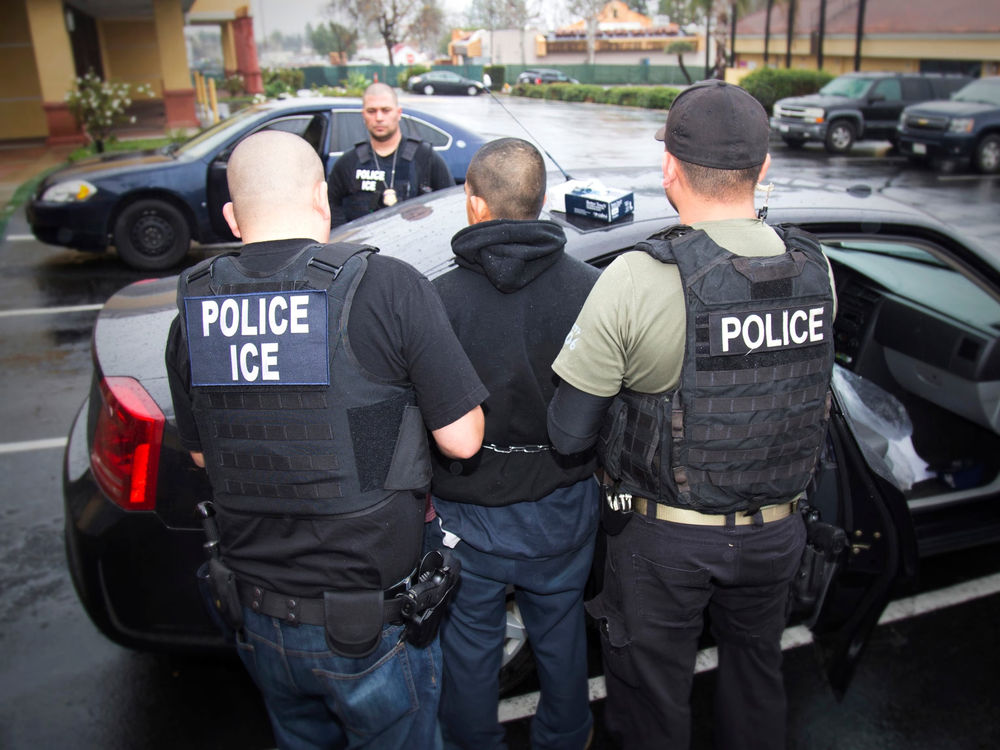
A number of outlets — including 404 Media — have reported that ICE is using two tools known as Tangles and Webloc to track the location of cellphones without a warrant. The tools are offered by a company called Penlink, which says on its website: "Enhance your investigations with automated, AI-powered open-source intelligence. Boost your workflow with Tangles — our AI-driven OSINT platform. Automate the search and analysis of data from the open, deep, and the dark web. Tangles allows you to uncover hidden connections, monitor threats in real time, and transform vast data into actionable insights quickly and efficiently." Nathan Freed Wessler, deputy director of the ACLU's Speech, Privacy, and Technology Project, told 404 Media that Webloc in particular "is a very dangerous tool in the hands of an out-of-control agency. This granular location information paints a detailed picture of who we are [and] where we go."
While Webloc tracks a phone's location over time, with significant granularity, Tangles is a social-media monitoring tool that can detect faces in images and then identify them based on other public data. It can also do a sentiment analysis on a person's posts, categorizing them based on emotion. This has been used in the past to monitor the posts made by protesters at Black Lives Matter events. But didn't the Supreme Court rule in 2018 that authorities need a warrant before they can get access to or search cellphone location data from telecom operators? It sure did. But according to the ACLU, which got access to and published documents from ICE, the agency has obtained a legal analysis that suggests the same protection doesn't apply to Webloc's service because it uses the location data that phones broadcast so that web browsers and various apps can show users advertising. In other words, it's publicly available. From the ACLU:
We filed a Freedom of Information Act lawsuit against DHS in 2020 for records about its practice of purchasing bulk access to cell phone location information gathered from smartphone apps. In 2022, we posted thousands of pages of previously unreleased documents, but our litigation continued, and today we are publishing the additional records we’ve obtained over the last several years. Among the new documents is a two-page legal memo from ICE, providing our most detailed look yet into the agency’s attempt to craft a legal justification for purchasing access to highly sensitive location information without a warrant. The memo claims that the purchased location information is different from the cell phone location data at issue in Carpenter v. United States, an ACLU case in which the Supreme Court ruled that the government needs a warrant to obtain cell phone location history directly from cellular service providers.
The ACLU goes on to note that in one document included in the ICE collection, data broker Venntel explains how its data aided in tracing one device observed at multiple locations throughout the U.S. and Mexico. In multiple cases, Venntel also provided what are sometimes called “geofence” capabilities, which enable law enforcement agencies to identify every device within a specified area. The same documents describe how Customs and Border Patrol tracked phones to “locations of law enforcement interest” and monitored travel patterns. A Secret Service email exchange explains how the data could be used by investigators to identify “mobile devices carried near popular border crossing points into the U.S. and pull up the historical location data for those devices, viewing where they've been in the preceding months. It's worth noting that ICE is no longer just hunting illegal immigrants, and has now defined protesters in some cases as potential terrorists and therefore presumably targets for surveillance and arrest.
Surveillance shopping spree

The Electronic Frontier Foundation reported that Immigration and Customs Enforcement has a new budget under the current administration, and they "are going on a surveillance tech shopping spree."
Standing at $28.7 billion dollars for the year 2025 (nearly triple their 2024 budget) and at least another $56.25 billion over the next three years, ICE's budget would be the envy of many national militaries around the world. Indeed, this budget would put ICE as the 14th most well-funded military in the world, right between Ukraine and Israel. Of course, ICE doesn’t just end up targeting, surveilling, harassing, assaulting, detaining, and torturing people who are undocumented immigrants. They have targeted people on work permits, asylum seekers, permanent residents (people holding “green cards”), naturalized citizens, and even citizens by birth. A 2022 report by Georgetown Law’s Center for Privacy and Technology found ICE spent approximately $2.8 billion between 2008 and 2021 on surveillance, data collection and data-sharing programs.
As the EFF notes, ICE has indicated that they intend to spend between 20 and 50 million dollars on building and staffing a 24/7 social media monitoring office with at least 30 full time agents to comb every major social media website for leads that could generate enforcement raids. And it’s not just your digital habits ICE wants to surveil: they also have contracts with multiple automated license-plate reader companies, which means that agents can follow the driving habits of a large percentage of Americans. ICE uses this data to track down specific people anywhere in the country. ICE also has a $6 million contract through a Thomson Reuters subsidiary to access ALPR data, and has persuaded local law enforcement officers to run searches on their behalf through Flock Safety's massive network of ALPR data. CBP, including Border Patrol, also operates a network of covert ALPR systems in many areas.
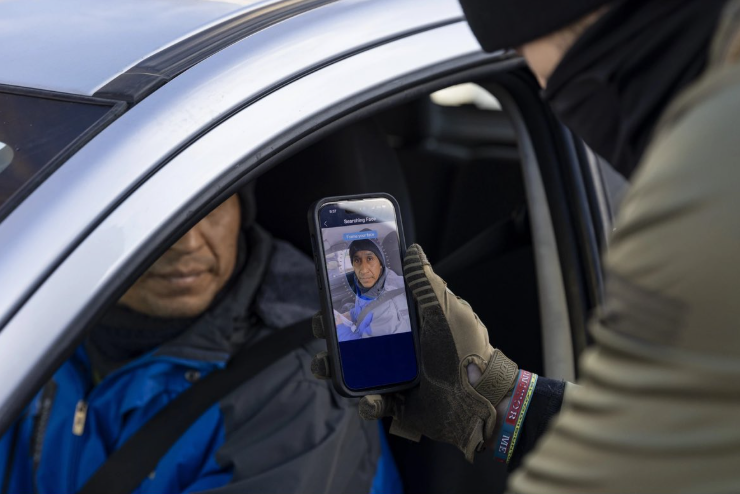
According to multiple reports, ICE has also invested in biometric surveillance tools, including face-recognition software called Mobile Fortify to scan the faces of people they stop to determine if they are here legally. The software checks the pictures it takes against a database of 200 million photos (the source of the photos is unknown). ICE also has a $10 million contract with Clearview AI for face recognition, and it has contracted with a company that offers iris scanning (agents have also been spotted wearing Meta’s Ray-Ban video-recording sunglasses). And ICE has bought a number of trucks that are equipped with Stingrays, or cell-station simulators. These can be used to set up a dummy phone network that can track any device that pings its receivers. While Webloc is used for historical location data, Stingrays provide real-time tracking.
If you thought this was as creepy as all of this police-state surveillance could get, you are sadly mistaken. According to a report from The Guardian, in early September, a woman who was nine months pregnant walked into the emergency obstetrics unit of a Colorado hospital. The woman, who was born in central Asia, checked into the hospital with a smartwatch on her wrist, but this was not an ordinary smartwatch: it was given to her by Immigration and Customs Enforcement agents, who told her she had to wear it at all times so the agency could track her. The device was beeping when she entered the hospital, indicating she needed to charge it, and she worried that if the battery died, ICE agents would think she was trying to disappear, hospital workers recalled.
This is the backdrop to the repeated waves of arrests and detention and even rendition of suspected "illegal aliens" that ICE has already carried out in multiple cities, and is now conducting via house-to-house searches in Minneapolis following the murder of Renee Good, a mother of three who did nothing but try to avoid a couple of ICE officers after dropping her kids off at school. The agency got an infusion of $75 billion from Congress, which is roughly equivalent to the military budget of Ukraine, and as large as Poland and Italy's defense spending put together. That suggests we have only seen the tip of a very unpleasant iceberg when it comes to the kind of surveillance machinery that the Trump administration plans to unleash on its own citizens.
Got any thoughts or comments? Feel free to either leave them here, or post them on Substack or on my website, or you can also reach me on Twitter, Threads, BlueSky or Mastodon. And thanks for being a reader.