Will AI destroy jobs or create jobs? Yes

One of the consistent drumbeats that has accompanied the rise of artificial intelligence, along with "Is it going to kill us?" and "Will it kill us and the planet?" is the idea that AI will lead to an epidemic of job losses, and possibly even the destruction of entire categories of jobs. We can see some of this in articles from the Wall Street Journal and CBNC, with headlines like "AI Is Wrecking An Already Fragile Job Market For College Graduates" and "Right now is a really difficult time to find a job,’ expert says." One recruiting firm says marketing companies are no longer looking for entry-level employees because AI can do it all; the CEO of another consulting firm told his own children not to focus on jobs that involve writing or data, but to choose those that require "people skills," like becoming a police officer (good advice until Robocop becomes a reality, I suppose). Anthropic founder Dario Amodei has said that he believes AI could wipe out half of all entry-level white-collar jobs in the near future. Here's the WSJ:
AI is accelerating trends that were already under way. With each new class after 2020, an ever-smaller share of graduates is landing jobs that require a bachelor’s degree, according to a Burning Glass Institute analysis of labor data. That’s happening across majors, from visual arts to engineering and mathematics. And unemployment among recent college graduates is now rising faster than for young adults with just high-school or associate degrees. Meanwhile, the sectors where graduate hiring has slowed the most—like information, finance, insurance and technical services—are still growing, a sign employers are becoming more efficient and see no immediate downside to hiring fewer inexperienced workers.
Top executives at industry giants like Amazon and JPMorgan have said in recent weeks that they expect their workforces to shrink considerably. Venture-capital firm SignalFire found that among the 15 largest tech companies by market capitalization, the share of entry-level hires relative to total new hires has fallen by 50% since 2019. “For the first time in modern history, a bachelor’s degree is no longer a reliable path to professional employment,” Gad Levanon, chief economist at the Burning Glass Institute, told CNBC. Although college graduates are still less likely to be unemployed than their non-degree counterparts, the advantage is smaller than it’s been in decades. Concerns about the economy, persistent inflation and a slowdown in consumer spending are also likely contributors to an erosion of entry-level opportunities, according to some researchers.
In February, a report from a firm called Citrini Research imagined the near future, and its pessimism led to a huge stock selloff. The company wrote that:
AI capabilities improved, companies needed fewer workers, white collar layoffs increased, displaced workers spent less, margin pressure pushed firms to invest more in AI, AI capabilities improved. It was a negative feedback loop with no natural brake. The human intelligence displacement spiral. White-collar workers saw their earnings power (and, rationally, their spending) structurally impaired. Their incomes were the bedrock of the $13 trillion mortgage market - forcing underwriters to reassess whether prime mortgages are still money good. This would have been manageable if the disruption remained contained to software, but it didn’t. By the end of 2027, it threatened every business model predicated on intermediation. Swaths of companies built on monetizing friction for humans disintegrated.
Is the hysteria overdone? The MIT Tech Review argues that it is. We've all heard the forecasts that white-collar jobs are going away, decimated by AI, the magazine says — waves of layoffs in the tech sector (most recently at Coinbase and Meta and Cisco) are said to presage what will soon come for all of us knowledge workers. "But before you quit your job as a software developer or financial analyst, and look to join the plumbers’ union," the magazine adds, "it’s worth considering today’s economic research on whether artificial intelligence has actually begun to devour white-collar work. The short answer is: No." Despite fears of an imminent jobs apocalypse that will destroy much of — if not most — such work, or the rumblings about a “permanent underclass,” Tech Review says there’s little evidence that AI has yet had any large-scale impact.
Note: In case you are a first-time reader, or you forgot that you signed up for this newsletter, this is The Torment Nexus. Thanks for reading! You can find out more about me and this newsletter in this post. This newsletter survives solely on your contributions, so please sign up for a paying subscription or visit my Patreon, which you can find here. I also publish a daily email newsletter of odd or interesting links called When The Going Gets Weird, which is here.
Extinction or evolution?

According to the MIT magazine, an analysis of the data gathered for the US Bureau of Labor Statistics shows that the unemployment rate for the jobs potentially most affected by AI is actually lower than that for occupations less exposed to the technology. And there are "no signs that large numbers of people are shifting from jobs threatened by AI to supposedly safer ones such as those involving mostly manual labor." All of the available evidence to date suggests that AI’s impact on current labor market conditions is likely small, according to Erika McEntarfer, a labor economist who headed the BLS until President Trump fired her last fall and is now a fellow at the Stanford Institute for Economic Policy Research. "What we know from history is that it takes time for innovations to work their way through changes in industries," she says.
A recent piece in The Argument agrees: Monthly jobs data, it says, "tells us what happened — it does not tell us why it happened." To isolate causes, economists often need to wait for more data to accumulate. Economists warn that the speed of AI adoption means that aggregate figures may take a long time to reflect real-world impacts on the job market or the economy in general. In an OpenAI paper published in 2023, the company forecast that "80% of jobs could have at least one-tenth of their tasks exposed to AI, and 19% of jobs could have at least half of their tasks exposed." But the term exposed doesn't necessarily mean the job is disappearing tomorrow. If a task can be sped up by 50-plus percent it is considered exposed. If a job has a lot of exposed tasks, well, it tends to be considered at risk, but "this is not how automation works in the real world."
Even the founders of the current leaders in AI, Anthropic and OpenAI, disagree on how disruptive the technology will be. According to Axios, Anthropic co-founder Chris Olah doubled down on some of the company's previous rhetoric at the Vatican's recent AI ethics conference. "There is a real possibility that AI will displace human labor at very large scale," he said. OpenAI CEO Sam Altman, however, says he has moderated his views about the disruption the technology will cause. He said that he was wrong about earlier projections that it would wipe out entire categories of jobs. "I'm delighted to be wrong about this, I thought there would have been more impact on entry-level white-collar jobs being eliminated by now than has actually happened," Altman told Commonwealth Bank of Australia CEO Matt Comyn at a conference.
Aaron Levie, the founder of cloud storage company Box, told Casey Newton of Platformer that rather than job loss, he sees AI changing the nature of existing jobs to the point where we have to call them something else. “If you or I go and vibe-code something, we think we've replaced the engineer, replaced the accountant, replaced the lawyer,” Levie told me. “But then you actually look — that was the first 80% of the job. The extra 20%, it turns out, is all the value creation of that profession. All the expertise and domain knowledge is in that last 20%, not the text that got generated.” Boris Cherny, the creator of Claude Code, was simultaneously the most pessimistic but also the most optimistic about the impact that AI is going to have — and already is having — on jobs. Here's Newton:
Cherny belongs firmly to the camp that believes the end of software engineering as we know it is already underway. He hasn't written a line of code himself in more than six months, and he says that for the kind of work he does, coding is effectively "solved." Given that he is, by his own account, actively automating his own job, it's no surprise that Cherny sees the disruption arriving far faster than our first two guests. He told me that the title "software engineer" could start to disappear by the end of this year, dissolving into something closer to something like "builder" as the designers, product managers, and managers around him start shipping code of their own. But his own jobs forecast is more optimistic — and in some ways similar to our first guests — than some of his more prominent comments about coding being “solved” might suggest.
Jevons Paradox
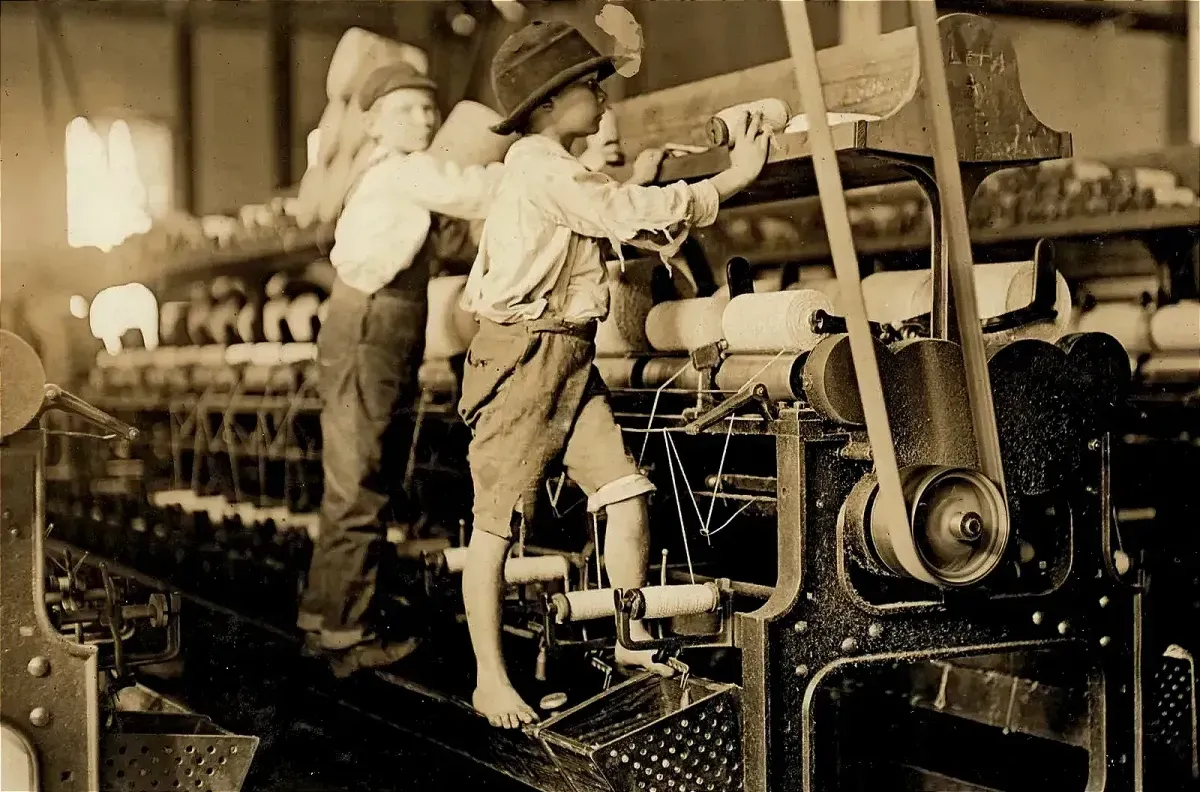
The argument from Cerny and Levie and others is that while some jobs might disappear in some sense of that word (like drones replacing snipers perhaps?) many jobs and categories of jobs will change and evolve as AI does more and more of the low-level computation, or writing, or researching of facts, or writing code. Analyst Benedict Evans, who recently came out with a presentation on how AI is eating everything, says one way of figuring out what might happen to jobs is to look at how other technology shifts — such as the arrival of PCs or the emergence of mobile telecom — have affected certain jobs. "Some of the industries that should have suffered most ended up much bigger, and some of the industries that did suffer most should have been immune," he writers. For example, technology like mainframes, databases, and PCs automated accounting, and yet the number of accountants has just kept increasing the whole time.
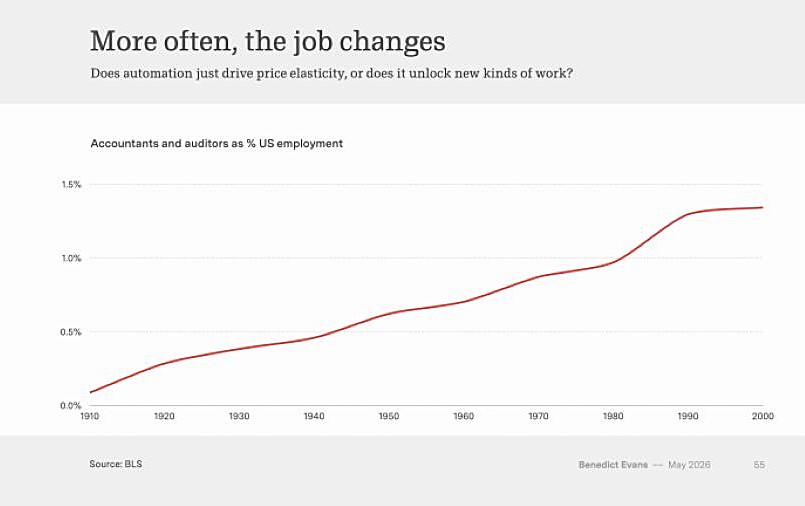
One thing that the AI job-doomers forget, Evans argues, is what economists like to call Jevons paradox, which (roughly translated) says that if you make it cheaper to do something, people and businesses often wind up doing more of that thing rather than less. As Evans puts it, "if you make it cheaper to do something, do you do the same for less money (or resources, or employees), or more for the same money, or does a new ROI mean you do more for more money?" Automation, he says, might mean more work rather than less, as it seems to have done with accounting. "If you automate something that used to be expensive and time-consuming, it can unlock other things. Accountants today aren’t doing exactly the same work that they did in 1970 or 1980 ‘but more’ — they’re still called ‘accountants’ but the job is different." New technology often starts out being used for ‘the old thing but more’, but it rarely ends up like that."
In a previous Torment Nexus post, I wrote about whether AI was more like the slide rule or the Industrial Revolution, and I quoted Harvard economist David Deming, who wrote about how the introduction of mechanical switching for telephone networks put thousands of human operators out of work. But at least some of those operators became typists and secretaries, driven by a new technology: the typewriter. "Over a period where the typewriter was rapidly adopted, the occupation of typists and secretaries grew sixfold," he writes. Philosopher Michael Huemer, meanwhile, has written about why he hopes that the arrival of AI will destroy jobs. In the Middle Ages, he notes, about 90% of the Western world's population were employed as farmers:
Since then, we developed harvesting machines, fertilizers, better crop breeds, etc., that vastly increase food production, so that one farmer of today can produce the output of something like 100 medieval farmers. Today, under 5% of the population are farmers, and we have a lot more and better food. Presumably, a lot of farmers were forced to stop farming along the way. If you follow the reasoning of section 1 above, this must have been a disaster. Why aren’t 85% of the population now unemployed? Somehow, we found new things for people to do. The increased mechanization of factories did not lead to mass unemployment, nor did the computer revolution.
Georgetown professor Harry Holzer, a former chief economist for the US Department of Labor, has noted that the arrival of the automobile put horse-and-buggy drivers out of business, but "the number of jobs that opened up in the auto industry — especially once Henry Ford created the assembly line and the Model T dropped in price, creating enormous demand in ways that couldn’t have been conceptualized 10 or 20 years earlier — produced not just new categories of jobs, but enormous numbers of jobs.” If you don't want to (or can't) transition from a horse-and-buggy job to making Model Ts, your view of technology is going to be different. But over the long term, society as a whole and the economy as a whole will (theoretically) be better off.
Got any thoughts or comments? Feel free to either leave them here, or post them on Substack or on my website, or you can also reach me on Twitter, Threads, BlueSky or Mastodon. And thanks for being a reader.